
There’s a moment that happens to me every now and then in Newfoundland, in the small rural communities, usually when I’m alone with a camera, when the place stops being a backdrop and becomes a conversation.
This post is my Top 10 Newfoundland photos of 2025. A year of cultural landscapes, outport conversations, and quiet rural solitude.
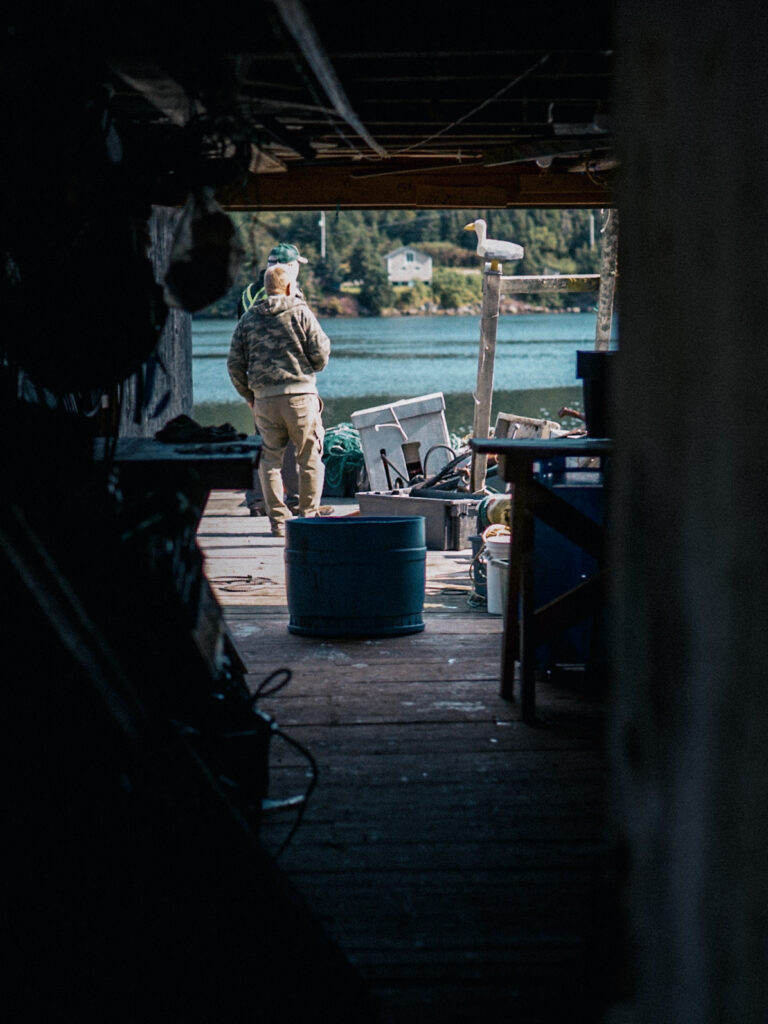
In mid-September, around 10 a.m. in Boat Harbour, I found myself inside a fishing stage I didn’t own, with two fellers I’d only just met, listening to stories that felt older than the wood around us. The morning had started cool, but the sun kept rising and rising until it warmed everything it touched. Outside was calm—no wind at all, which is its own kind of weather here. Inside the stage was cluttered in that familiar way: not messy, exactly… more like organized chaos, where the owner has a place for everything and can find any tool without looking. It smelled like old wood, gasoline, landwash, and the fish Claude had sitting in a tub. Wonderful!
I had spent the morning photographing Brookside and Boat Harbour, and in Boat Harbour I was stopped on the road by Morgan Walters. A stranger with two big camera bags, and a tripod slung over their shoulder is going to raise an eyebrow in a small community. Morgan asked what I was doing. I told him who I was, what I’ve been working on, and that I’ve been trying to document the cultural landscape of the Burin Peninsula: the places people have shaped, and the way those places shape people right back. I handed him my card. We talked.
Before he drove off down the road, he pointed out an old stage that belonged to Mr. Ross Matterface, and told me it was the home of a well-attended Tibb’s Eve party every year. These are the kind of details you don’t get from just looking. Then, shortly after, I crested a hill and saw a line of fishing stages tucked down a side road by the water. When I walked closer, Morgan called out again, this time from the stage of his friend, Claude Matterface, and the two of them invited me inside.
That invitation is the whole story, really.
I managed a few frames on both digital and film, but the real gift that morning was the yarning: the joking banter, the pride in their harbour, the way stories get told here with a punchline tucked inside them. There’s a toughness to rural Newfoundland that comes from weather, risk, and hard work, but there’s also this deep, playful humour running through every cove and harbour. The more I’ve leaned into those conversations this year, the more I’ve felt like I’m not just photographing scenes but that I’m starting to understand places faster, and able to photograph them more honestly.
These are my Top 10 photos of 2025, in no particular order. They’re a mix of cultural landscape and natural landscape, of locals and solitude, of planned shoots and the kind of moments that happen unannounced, and unexpectedly. If there’s a theme tying them together, it’s this: the best photographs I make usually live somewhere between luck and dedication, and this beautiful island of Newfoundland seems to reward both.
1) Lawn (January)
‘Bluebird Day’ at the Kelp
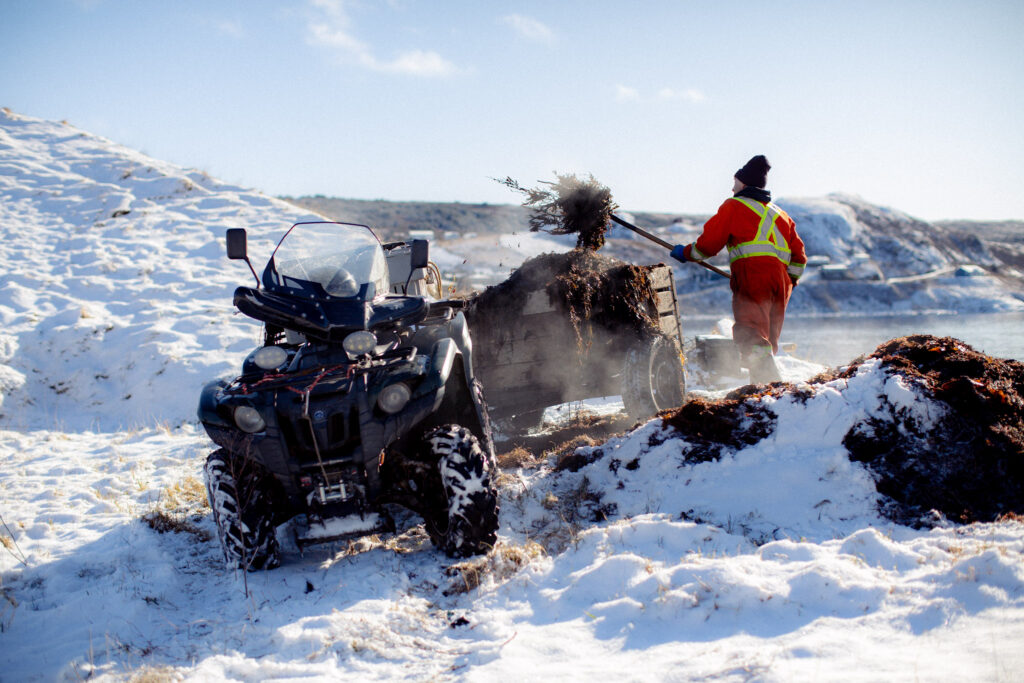
The beach of Lawn. Mr. Henry Kearney loading kelp onto his ATV cart on a bright bluebird day. (Buy Print)
I didn’t used to approach people when I was photographing. For years, I’d either keep people out of the frame entirely or shoot from a distance and keep them anonymous. But this scene in Lawn wouldn’t let me drive by.
It was January, and a light snow had fallen overnight. There was steam rising off a snow-covered pile of kelp as Mr. Henry Kearney loaded it onto his ATV cart. It was a cultural scene I’ve seen many times: a man working the landwash, harvesting what the sea gives up. The light was beautiful, the contrast was perfect, and the moment had that rare combination of grit and grace.
So I stopped. I introduced myself. I asked if I could take his photograph. He obliged, and we had a short but great chat.
That encounter ended up being a turning point for me. It pushed me out of a comfort zone I didn’t realize I’d been living in. It set the tone for the year: if you want to understand a place, you have to meet the people who live in it.
2) Admiral’s Cove & Grand Bank Cape (April)
First Medium Format Frame
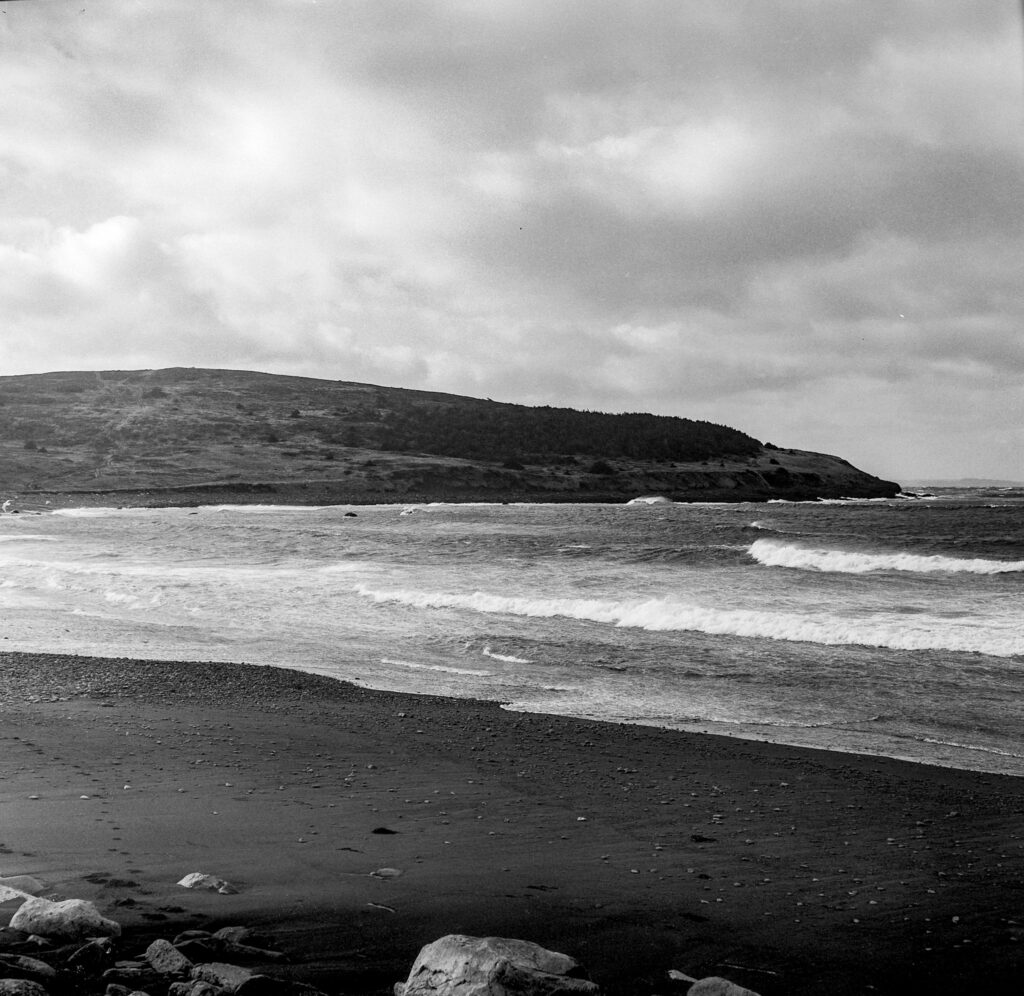
Admiral’s Cove and Grand Bank Cape on a bright, incredibly windy day. Shot on a 1951 Zeiss Ikon Nettar with Delta 100 film. (Buy Print)
This image is tied to a very specific feeling: the joy of making a photograph with a tool that demands your full attention.
I had just bought a 1951 Zeiss Ikon Nettar folding camera from a lady in Grand Falls while travelling across the island for one of my son’s hockey tournaments. I loaded it with Delta 100, and I was eager to see what it could do.
This was the first frame I shot with it.
The day in Grand Bank was bright, incredibly windy, and the wave action and contrast of light pulled me to this coastline. When I saw the final negative, I knew immediately it belonged in my year’s top set. Not just for the image itself, but for what it represented: getting reintroduced to the simple, hands-on magic of photography.
Field note: That Nettar has become more than a camera for me this year. It’s been an icebreaker, a conversation starter, and a reminder to slow down.
3) Harbour Mille, Good Friday (April)
Down the Hill
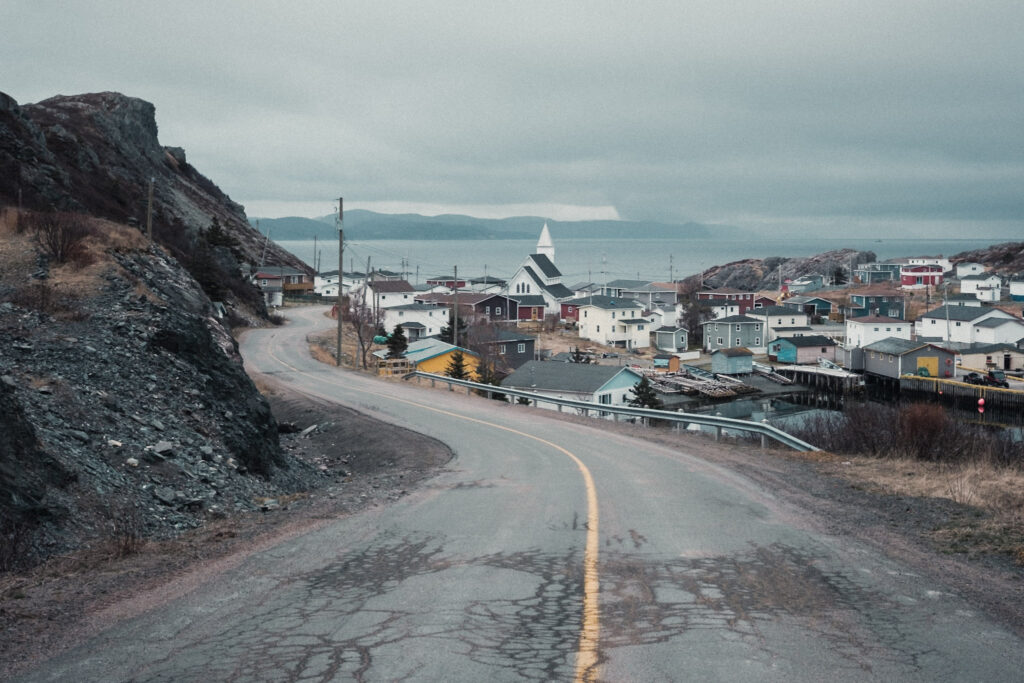
The weathered road leading down into Harbour Mille. An overcast morning that became something else entirely. (Buy Print)
I set out before sunrise with one goal: dramatic light in the Rushoon area. But as I drove, it became clear there would be no beautiful light, just a dreary, dull, overcast.
So I kept going. All the way to Harbour Mille.
As I entered the community, this scene just hit me. The road pulled straight into town like a sentence you couldn’t stop reading, leading your eye toward the cluster of houses and the church standing quietly over everything. I pulled over and shot it fast, because sometimes you get the feeling a place is offering you something and you shouldn’t argue with it.
What I didn’t know then was that this trip to Harbour Mille would become a genuine turning point in my year. This photograph feels like the establishing shot for that shift. When the day didn’t give me the landscape I wanted, but gave me the stories I needed.
4) Harbour Mille, Good Friday (April)
Lloyd’s Stage
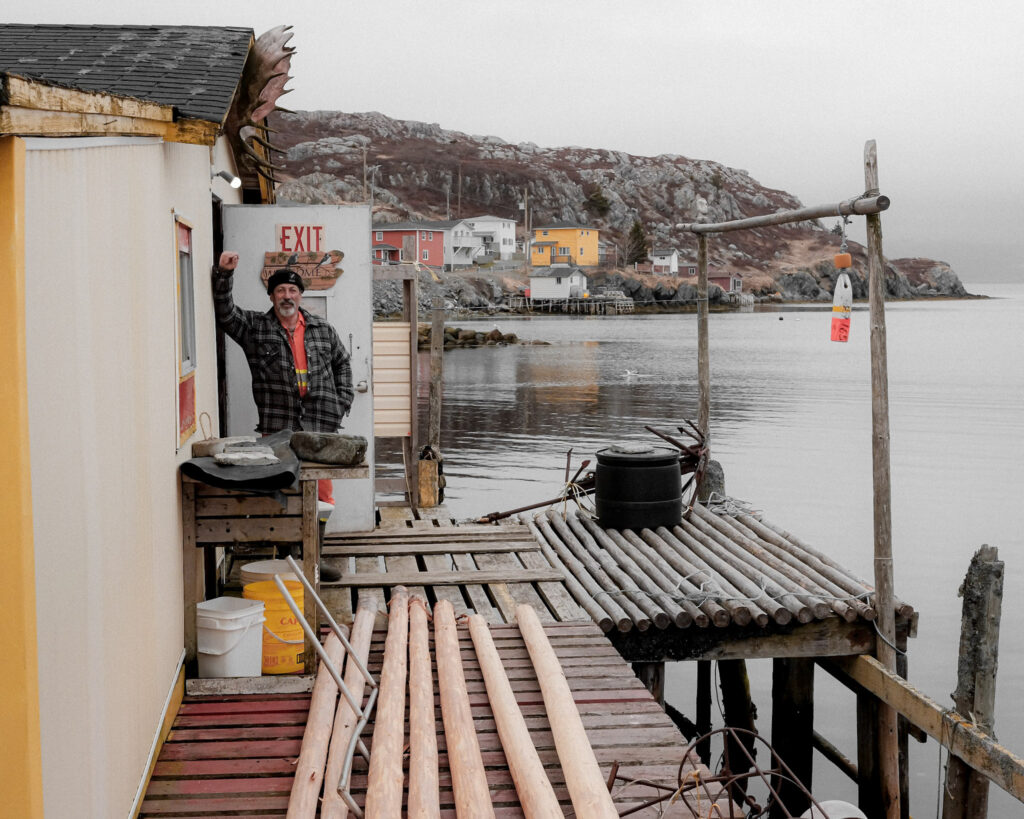
Lloyd Pardy posing on his fishing stage before heading to his cabin at the resettled community of Femme. (Buy Print)
That Good Friday morning, I found myself doing the opposite of what I planned: instead of chasing dramatic light, I was walking the harbour front, photographing the cultural landscape—stages, wharves, working spaces, the bones of the place.
I noticed one stage with the door open and hesitated. I wanted the photograph, but I didn’t want to make anyone uncomfortable. That hesitation reminded me of Mr. Kearney back in Lawn, and I made a decision: instead of sneaking a frame, I’d wait. I’d introduce myself. I’d do it properly.
When Lloyd Pardy stepped out, we had a wonderful yarn. I had three cameras around my neck, and I asked if he’d let me make a portrait of him on his stage. He was patient while I shot him on both my Canon DSLR and my vintage folding camera.
That conversation confirmed what I’d already started to learn: if you just show up respectfully, and you’re honest about what you’re doing, people will often meet you with warmth. That morning in Harbour Mille, I met and chatted with four other people as well. I drove home feeling welcomed, and recharged. It was like a fire had been re-ignited within me after being burned out for years.
5) Grand Bank (June)
Mist at Admiral’s Cove
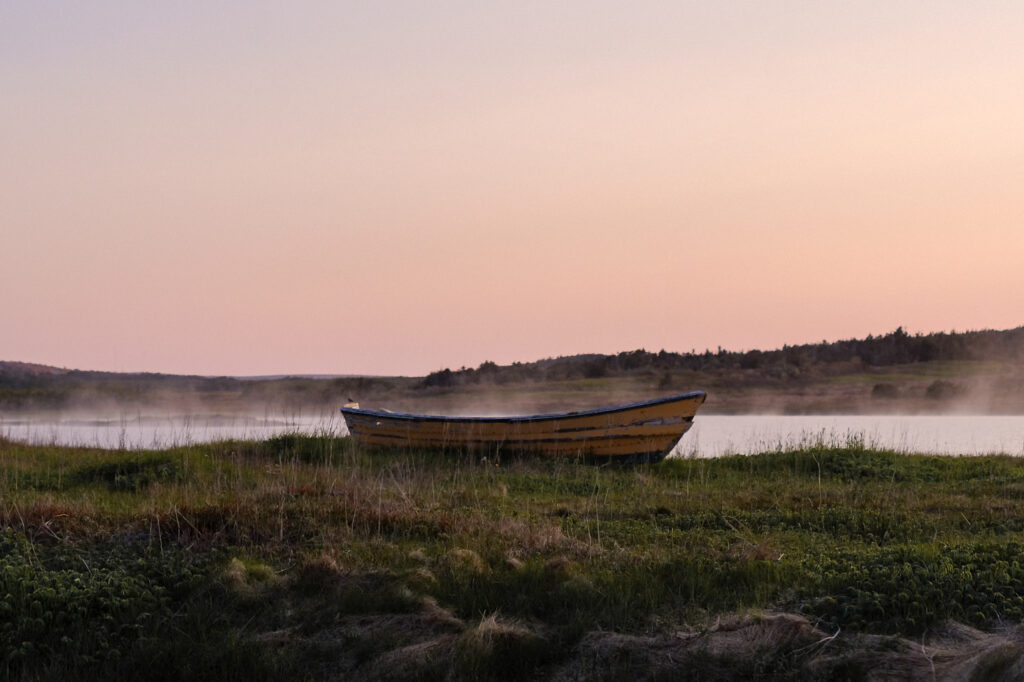
An abandoned dory in a field at Admiral’s Cove as the sun sets and mist envelops the pond. (Buy Print)
This photograph happened because I noticed something out of the corner of my eye and refused to let it go.
Earlier that evening, I was shooting a rare portrait session, and the last stop was up by the lookout on Point Bouilli. While I was there, I spotted a huge amount of steam and mist rising around Admiral’s Cove Pond behind that old dory. I knew the light was about to change, and I knew it wouldn’t wait for me.
So I rushed home, grabbed my tripod and film cameras, and got back just as the sky started to soften with a pop of colour. The scene felt quiet, beautiful, but a little lonely, like it had been sitting there for years waiting for the right kind of evening.
The timing was perfect: I had just received a new photo printer that week, so this was the image I used to test paper types and tones. It became one of those rare photos that lives in both worlds for me: a field moment I’ll always remember, and a print that taught me something about my process.
6) Near L’Anse au Loup (June)
The Best Week
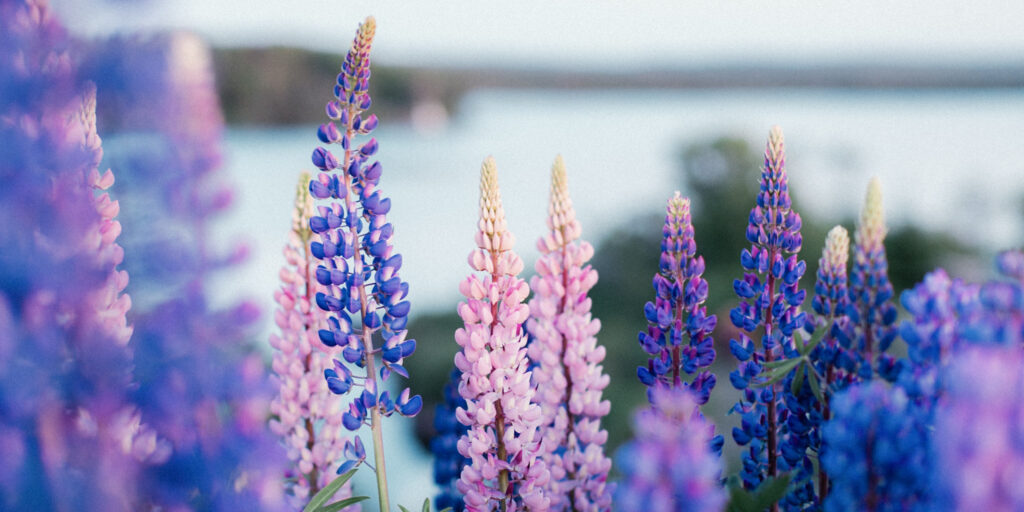
Lupins overlooking L’anse au Loup Country Pond (Buy Print)
My favourite week of the year is the one between the June Holiday (formerly Discovery Day) and Canada Day.
The sunsets are late. The air is warm but not humid. There are fewer mosquitos and earwigs. Birds are singing. Whales chase capelin into the bays. And the wildflowers—blue flag irises and lupins especially—start to take over.
Lupins have been a favourite of mine since I was a kid. For the first eight years of my life, I lived in the basement apartment of my grandmother’s house on Hickman Street. Mrs. White lived next door in a shingle-clad saltbox house painted yellow and brown, with a fence and gate at the end of a cement walkway painted in grey fisherman paint. Between her house and that walkway was a big garden of lupins. I can still smell it: the fresh fisherman paint mixed with the fragrance of the flowers. In my mind, that smell is the beginning of summer. Optimism, freedom from school, time to explore.
I’m always watching for lupins to photograph, but they’re often stuck in disturbed areas with ugly backgrounds. This group, despite being near the highway, overlooked L’anse au Loup Country Pond, a place I spent so many summer days rowing with friends.
Summer officially started with this photograph.
7) Grand Bank Cape (July)
Between Three Stones
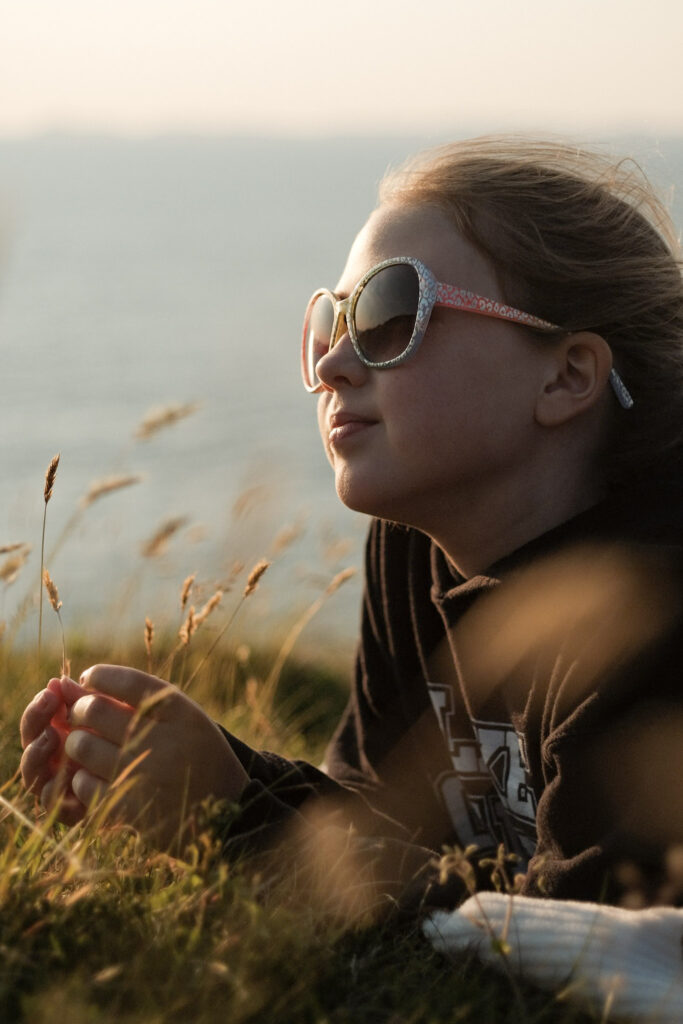
My daughter relaxing in the wild grasses of Grand Bank Cape.
Portraits used to be my bread and butter. I spent over a decade shooting weddings, proms, and family sessions, until I burned out on the service side of photography and stepped away from weddings entirely, and seriously scaling down portrait work.
But I still can’t help it sometimes, and now, my family has become the centre of that part of my photography.
On this day, my wife and daughter joined me on one of my many trips to “the Cape.” Grand Bank Cape is my favourite place in the world. I feel connected to it in a way I can’t fully explain, and there’s one specific area—between three stones—that I love the most. I find therapy there: the sights, the sounds, the smell, the way the wind and salt air soothes the soul. I sit in the grass and watch cormorants pass, finback whales surface briefly, savannah sparrows chirp as they collect seeds, and I look down upon the town I love.
Sharing that place with my family feels like a privilege. Capturing a moment where my daughter was enjoying it in her own quiet way warmed my heart, and that’s why this image belongs in my personal top ten.
During that same trip, she and I came up with an idea we’re excited about completing: our own personal map of the Cape. A watercolour map where we write our own names for the places we visit. Parsons’ Point. Ralph’s Ridge. Butterfly Valley. A family geography layered on top of the real one.
8) Boat Harbour (September)
An Invitation Inside
Shot through an open doorway toward two men at the edge of a fishing stage. More conversation than photography, in the best way. (Buy Print)
This photograph is the heart of what I was chasing in 2025.
I spent over an hour inside that stage after Morgan and Claude invited me in. I shot a few frames on digital and on my old folding camera, but what mattered most was the talk. The stories about the stages, the old mill, the way history lives inside a harbour when someone’s willing to tell it.
It’s funny: I’ve always loved letting cultural landscape photographs speak for themselves. But this year taught me something. There’s value in encouraging the people who live within that landscape to open up and share their sense of place, their life stories, their pride, and their humour. It adds an extra element to the work that I’ve been increasingly chasing.
If 2025 has a photographic lesson for me, it’s this: walk into the moment. Introduce yourself. Earn the photo.
9) Near Red Harbour (October)
Scarlet Barrens
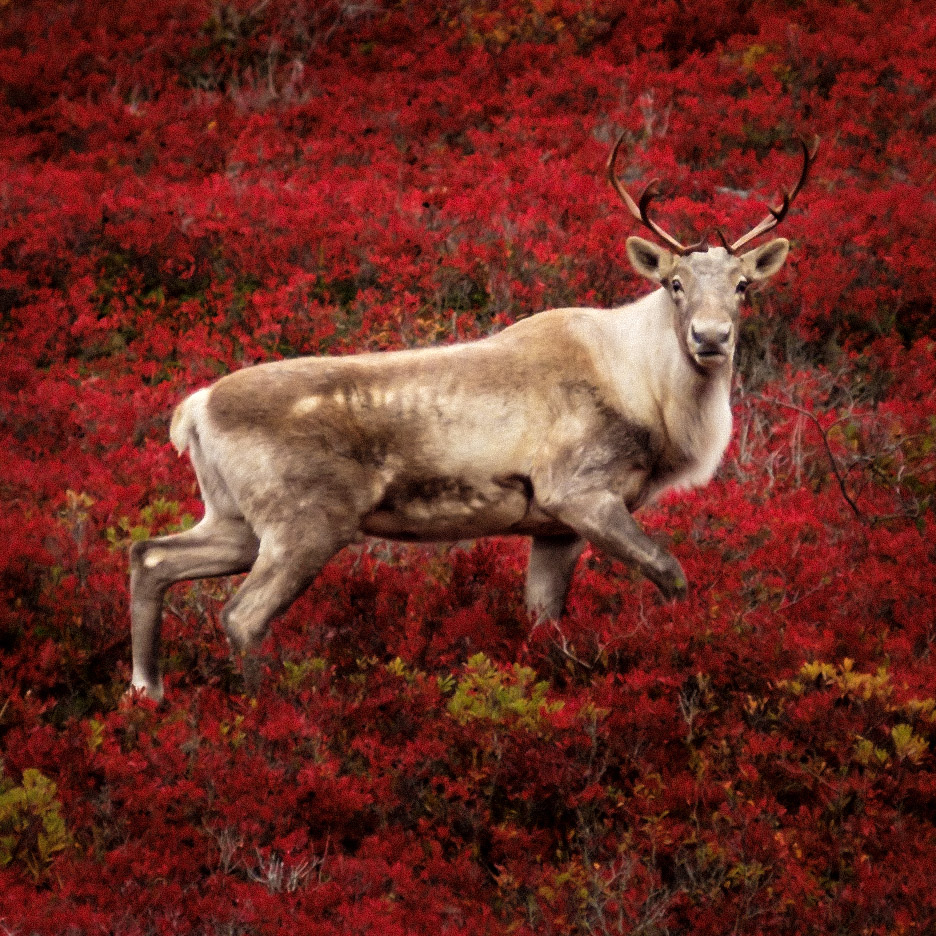
A caribou pauses in bright red blueberry bushes—then disappears over the ridge. (Buy Print)
For twenty years, I’ve carried a camera up and down the Burin Peninsula highway waiting for a specific moment: a caribou in winter, big antlers, snowy field, steam rising from its nose as it turns to look at me.
It’s my bucket list shot. I’ve imagined it for years.
I’m not a wildlife photographer, not in the way those guys do it. I’m not trekking deep into the woods and camping out for days, waiting. I’m far too impatient. If I’m going to get wildlife, it’s going to be opportunistic, close to the highway, and fast.
On the morning of October 7, driving to St. John’s for my wife’s medical appointment, I caught a glimpse of caribou just past Red Harbour—two of them—against the bright red of autumn blueberry bushes. I pulled over, jumped out, and they vanished into the trees. I thought it was over.
I had brought my smaller, more portable camera that day. My Fuji X-T2. My longest focal length on hand was a vintage Vivitar 135mm, adapted, full manual focus, crop sensor. Not ideal. But I jogged up the roadside anyway, hoping they’d reappear.
They did.
They ran along with me, then emerged into the open scarlet barrens like something out of a dream. One paused for three or four seconds—just long enough—looked straight at me, and I managed to manually focus and fire off a couple of frames before they crested the ridge and disappeared. The whole experience lasted maybe 45 seconds.
It felt like vindication for all those years of carrying a camera “just in case.” It reminded me: the image you get is often not the image you planned, but sometimes it’s the one you needed.
10) Swab’s Dock near Grand Beach (October)
Before Work
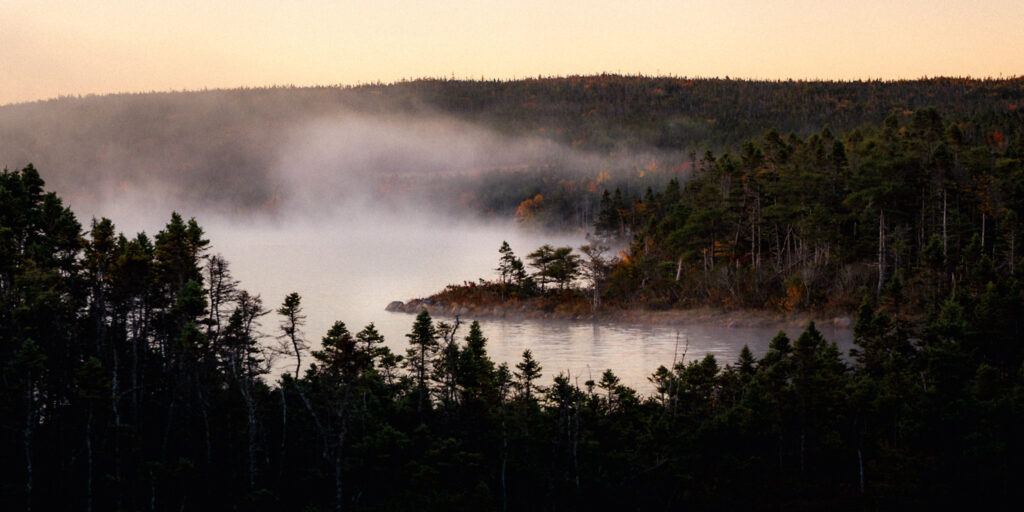
Mist lifting off the pond as sunrise breaks through. Found by accident when plans changed. (Buy Print)
I drive 54 kilometres from Grand Bank to Marystown every weekday for my day job. With kids to get on the bus, I don’t get many chances to leave early and shoot along the way, even when I’m driving through ridiculously good morning light.
All fall, I’d been watching scenes go by through the windshield, unable to stop. I tried twice on weekends to photograph the areas I had in mind, but the conditions weren’t right: wind, rain, no atmosphere.
Then on October 13, I got lucky.
I left Grand Bank intending to stop at Crouse (Grouse on the map, but locals and local histories confirm the name is Crouse). But when I arrived, a group of moose hunters were gathering to head in on the same path I’d planned to hike. With no subject and the morning light slipping away, I kept driving, hoping to stumble onto something.
Then, near the top of the hill before Grand Beach, I saw it: a huge bank of mist over the pond and highway, sunrise blasting through it.
Success! Better than the original plan.
It happens more often than not: while planning has its merits, there’s something about letting the light and intuition guide you. Some of the best scenes I’ve ever made were found that way. This was one of them.
The Road Keeps Going
If I had to sum up 2025 in one photograph, it would be the caribou—not just because it was popular with my followers, but because it holds the lesson I keep re-learning.
For twenty years, I’ve chased a caribou moment I could see in my head. When it finally came, it arrived in a completely different mood, scarlet instead of snow, autumn instead of winter, an old lens on a crop body camera, instead of the setup I would have chosen. It was both the result of dedication and the gift of spontaneity. A mix of luck and commitment.
The fact that I didn’t have my preferred camera or lens didn’t matter. The best camera is the one you have with you, and that day, I’m thankful I brought one, like I always do.
That’s what being a photographer feels like to me right now: keep showing up, keep paying attention, keep talking to people, keep following the light… and let Newfoundland, in its own way, pull you toward the stories you didn’t know you were looking for.
Keep Exploring
If you’re interested in the bigger story behind these photographs, my About page explains the long-form project I’ve been building across Newfoundland. And if any of these scenes feels like home, or feel like they should be in your home, prints are available in my Print Shop. Books are available through my Landwash Market.